 Most seen
Language
EnglishCurrency
US dollar · $GetYourGuide converts to the currency you select here.
Guide · Whales
Southern right whale watching in Hermanus: who you will meet
Walker Bay belongs to the southern right whale every winter, but it is not alone. Meet the whales of Hermanus, learn how to tell them apart and find out when each one is around.
Check availabilityfrom $96 · free cancellation
Editorial team, whale-watching-hermanus.comUpdated October 5, 2026about 7 min to read10 sources
In short
- 01Main species
- Southern right whales come to Walker Bay to calve and mate.1
- 02Also seen
- Humpback and Bryde's whales visit the bay too.2
- 03Calves
- A southern right mother calves about every 3.12 years.3
- 04Close to shore
- At some points whales come within five meters of the shore.4
- 05When
- They are in the bay from June to November, best August to October.5
The whale that made Hermanus famous
Southern right whale watching in Hermanus is what the town is known for, and the reason is simple: these whales come here on purpose. They migrate from the Antarctic around June to calve and mate in the shelter of Walker Bay.1 Instead of passing by on a long journey, many of them settle into the bay for weeks, which is why visitors can watch the same mothers and calves day after day.
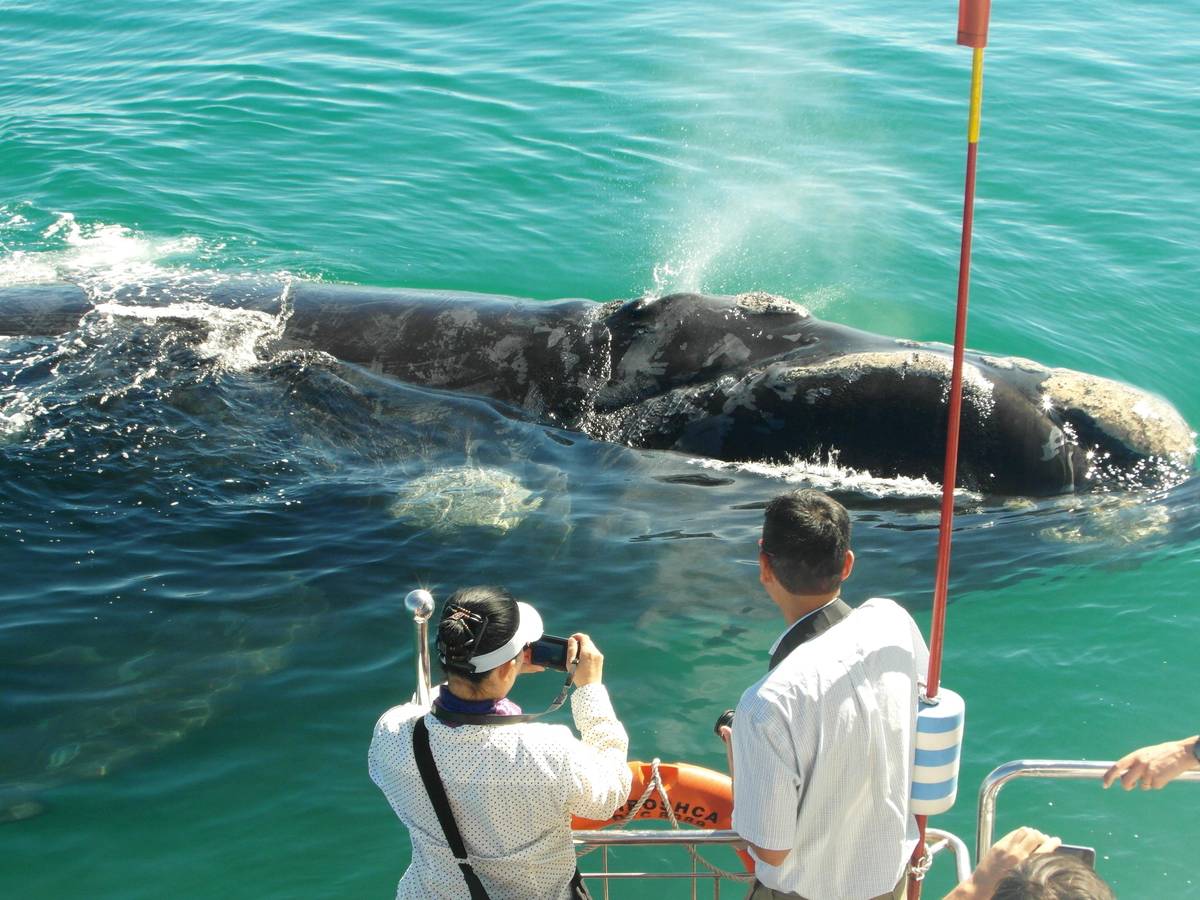
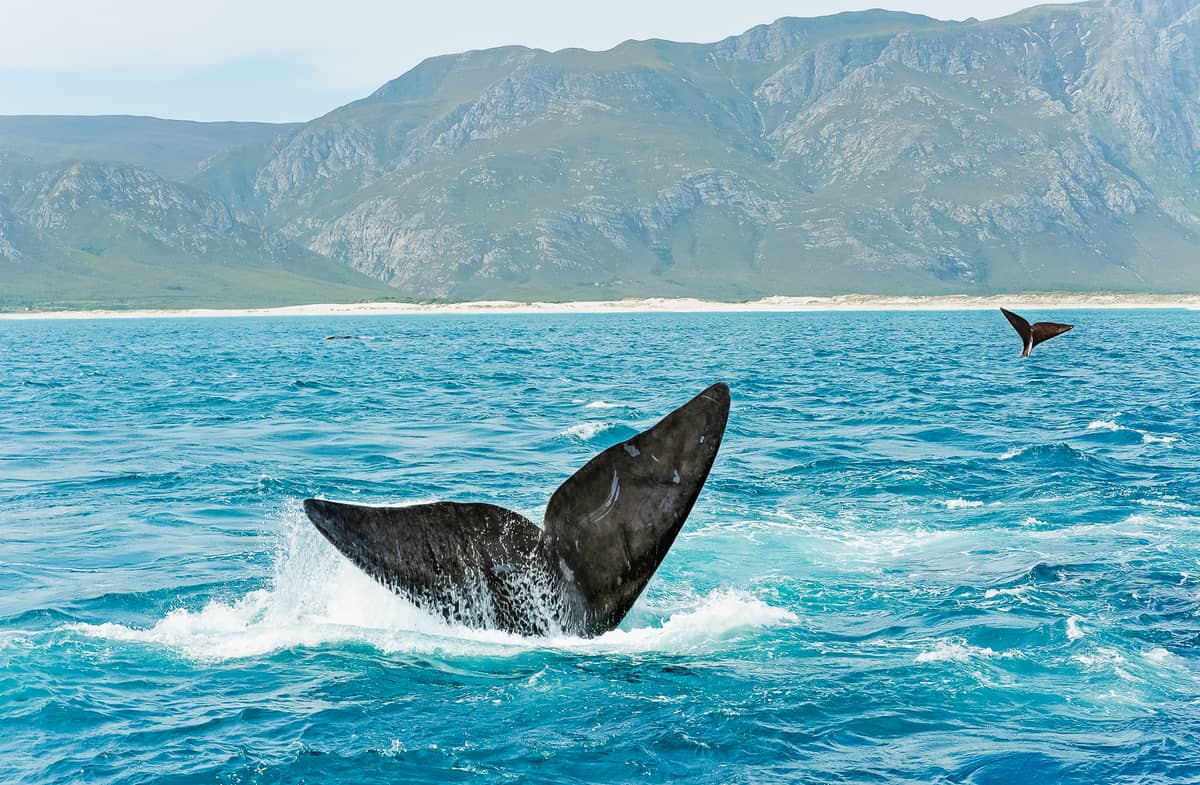
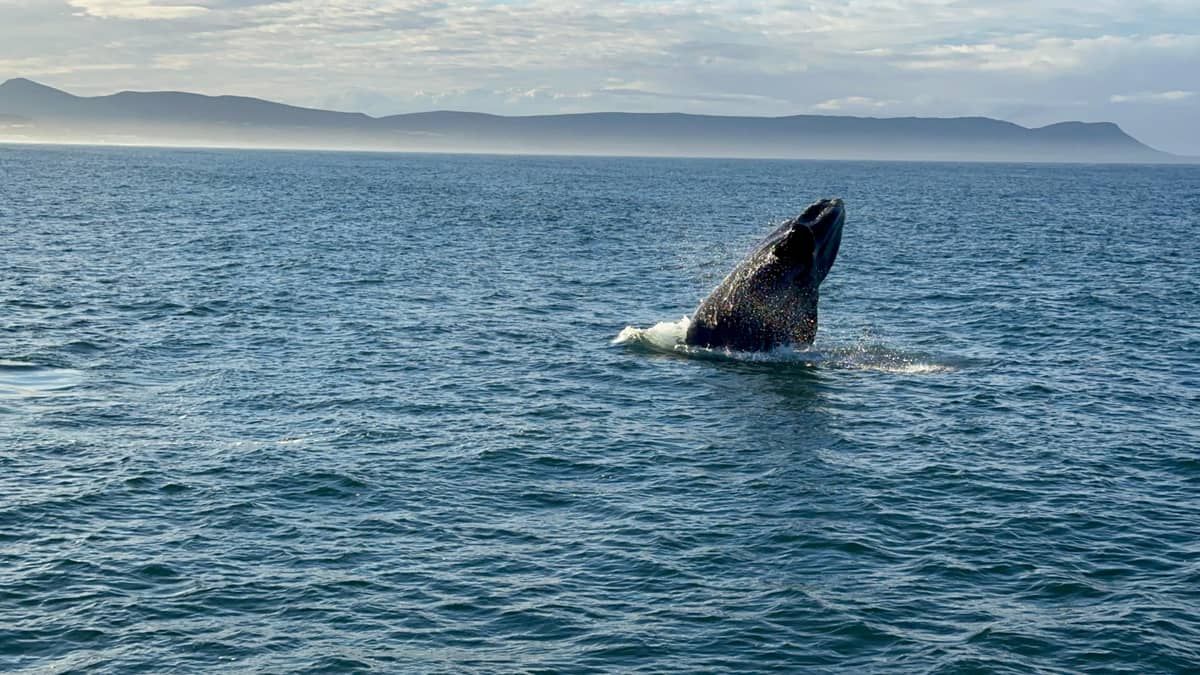
Seen up close, a southern right is unmistakable. It is broad and dark, with no fin on its back, and its head carries rough pale patches that look like barnacled islands. When it breathes, the blow often splits into a wide V. The whales move slowly when they rest, and they spend a lot of time near the surface, rolling, lifting a flipper or raising their tail above the water.
That calm behaviour is what makes this bay so special for watching. On a still morning you can follow a mother as she rests with her calf alongside, then watch the calf practise breaching in short, splashy bursts. From the boat or from the cliffs, the experience feels less like spotting wildlife and more like spending time with neighbours who come back every year.
History and life cycle
The southern right whale and Walker Bay
-
1935
Protection
Southern right whales are protected.6
-
1951 to 1970
Illegal hunt
Soviet fleets illegally take 3,212 whales, slowing recovery.6
-
Every June
The return
Whales migrate from the Antarctic to Walker Bay.1
-
August and September
Calving
Calves are born in the sheltered bay.1
-
October
Mating
Males arrive and the population peaks.1
-
About every 3 years
The next calf
The mean calving interval is 3.12 years.3
Types of whales in Hermanus
The types of whales in Hermanus that visitors talk about most are easy to list. CapeNature names the southern right, the humpback and Bryde's whale as the whales that can be seen in the sheltered bay.2 The southern right is by far the star of the season, but the other two add variety, and a good day on the water can bring more than one species.
Humpbacks are travellers. Hermanus.co.za says that, depending on the time of the season, you may see migrating humpback whales or the resident Bryde's whales.7 Humpbacks are the acrobats of the group, with long white flippers and a habit of slapping the water or showing their tail as they dive. When they are in the bay, they tend to move more than the resting southern rights.
Bryde's whales are the quiet residents. They are slimmer and faster, with a small curved fin on the back, and they surface briefly before slipping away. Because they live in these waters, they are the whales you are most likely to meet outside the southern right season, although they are harder to follow and photograph than their bigger, slower cousins.
Field guide
How to tell the whales of Hermanus apart
| Whale | Fin on back | Blow | Typical behaviour | When |
|---|---|---|---|---|
| Southern right | None | Often V-shaped | Rests at the surface, raises its tail | June to November |
| Humpback | Small, on a hump | Single column | Long flippers, deep arched dives | On migration |
| Bryde's whale | Small and curved | Single column | Short surfacing, changes direction | Through the year |
Species and seasons from CapeNature and Hermanus.co.za; the recognition features are general field marks.275
The whales
Walker Bay's whales, side by side
Most seen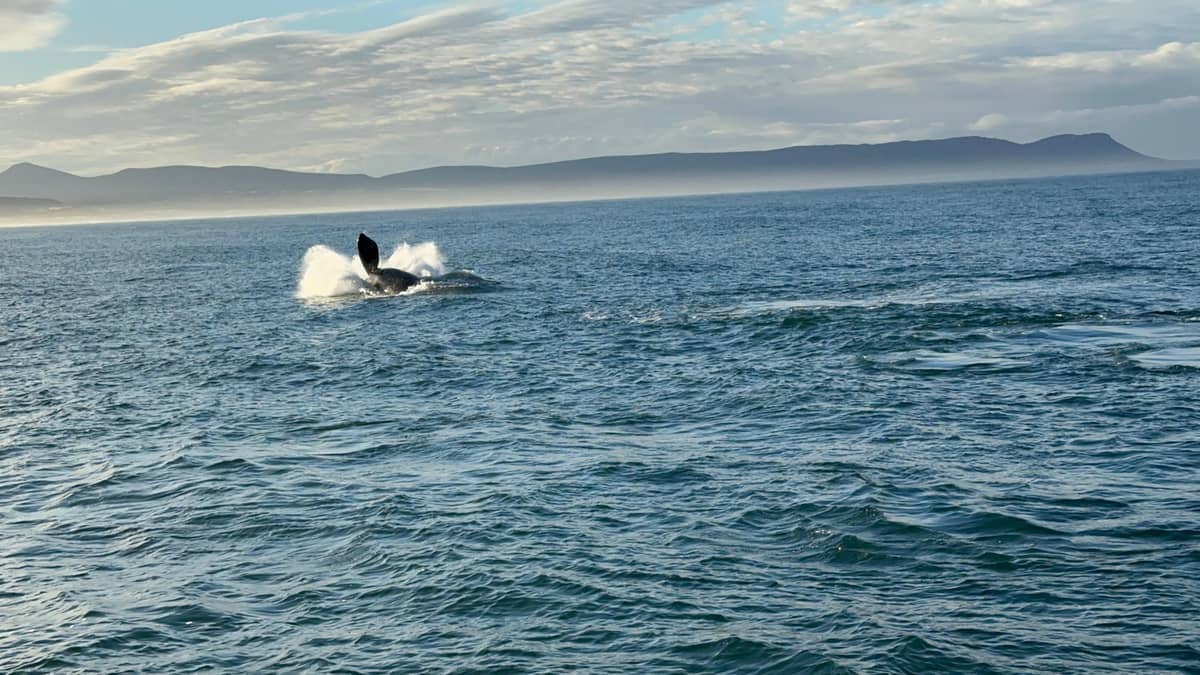 Seasonal
Humpback
The traveller
- Fin on back
- Small, on a hump
- Flippers
- Long and white
- When
- On migration
 All year
Bryde's whale
The resident
- Fin on back
- Small and curved
- Body
- Slim and fast
- When
- Through the year
Decision helper
What do you most want to see?
Tap your wish and see when to come
August or September
Calving takes place in these months.1
October
The population peaks when the males arrive.1
The Cliff Path
At some points whales come within five meters of the shore.4
A boat trip
Bryde's whales live in these waters all year.7
Mid-season, with luck
They pass through on migration at times in the season.7
Take a scenic walk along the coast to see the southern right, humpback and Bryde’s whales play in the sheltered bay.
Mothers, calves and the rhythm of the bay
The life of the bay follows the calving cycle. Calving takes place in August and September, and the males arrive for mating in October when the whale population peaks.1 Earlier in the season, South African Tourism notes, most pregnant mothers have arrived by August and September.8 This is the time to see tiny calves taking their first breaths beside their mothers.
Southern right mothers do not calve every year. A study published by the International Whaling Commission estimates the mean calving interval for southern right whales off South Africa at 3.12 years.3 That long gap between calves is one reason the population needs protection, and also why every mother and calf in the bay is worth a respectful distance.
Watching a mother and calf is a lesson in patience. The calf stays close, often touching its mother, and both rest at the surface between short dives. When the calf grows bolder, it rolls, slaps the water and breaches, sometimes many times in a row. If you see this from the boat, stay quiet, keep your camera ready and let the moment unfold.
Checklist
Spotting whales like a guide
01
What to look for
- A blow on the horizon, often in a V for southern rights
- Splashes from a breach or a tail slap
- A dark back with no fin, rolling slowly
02
What helps
- Binoculars on the cliffs
- Calm, bright mornings with little wind
- A specialist guide on the boat
03
What to respect
- Keep your distance and your voice down
- Never throw anything into the sea
- Follow the crew's instructions on board
Video
Majestic Hermanus Whales: South Africa's Spectacular Ocean Giants
Until you tap play, the video stays unloaded.
Whale and dolphin watching in Hermanus
Whales are not the only reason to look at the water. The trip sold on this site is a whale and dolphin watching boat trip, and its operator says Bryde's whales and dolphins can be seen through the year. For many visitors, a pod of dolphins riding the bow wave is the moment that makes the whole family cheer.
Whale and dolphin watching in Hermanus works best when you stay open to whatever the bay offers on the day. Dolphins can appear suddenly, race alongside for a few minutes and then vanish, while whales give long, slow encounters. A specialist guide on board helps you recognise what you are seeing and explains the behaviour as it happens.
Seals and seabirds complete the picture. Gulls follow fishing boats, cormorants dive near the rocks, and seals sometimes lift their heads to look at the boat. None of these is guaranteed, but keeping your eyes moving between the horizon and the water close to the hull is the best way to notice everything that shares the bay with the whales.
A protected species with a hard past
The southern right whale was hunted heavily in the past. According to SANBI, it was protected in 1935, and numbers are presumed to have grown until the 1960s, when 3,212 animals were hunted illegally by Soviet fleets between 1951 and 1970.6 That illegal hunt delayed the recovery of the population for years.
Today the whales in Walker Bay are protected by strict rules. South African law requires everyone to keep 300 meters away from any whale, unless they hold a permit that allows a closer approach.9 Licensed boat operators work under such permits, which is why a boat trip with a permitted operator is the only legal way to get close on the water.
The bay itself is part of a wider protected area. CapeNature describes Walker Bay as a coastal nature reserve with five coastal areas between Hermanus and Die Dam near Struisbaai.10 Respecting the whales here means following the rules on the water and on the cliffs: keep noise down, do not throw anything into the sea and give the animals space.
How to tell the whales apart
At first every dark back in the water looks the same, but a few clues help. Look for a fin on the back: southern rights have none, while humpbacks and Bryde's whales do. Watch the blow: a southern right's blow often splits into a V shape, while other whales usually blow in a single column. And watch the head: the pale, rough patches on a southern right's head are unique to the species.
Behaviour helps too. Southern rights often rest motionless at the surface or lift their tails and hold them in the wind. Humpbacks show long white flippers and tend to arch their back sharply before a deep dive. Bryde's whales surface quickly, blow and disappear, often in a different spot each time, which can make them hard to follow.
Your guide will help, but it is fun to learn to spot the differences yourself. Take a few photos of each encounter and compare them later: the shape of the back, the head and the tail tell the story. By the end of the trip you will start to recognise a southern right at a glance, even from the cliffs.
Watching from land or from a boat
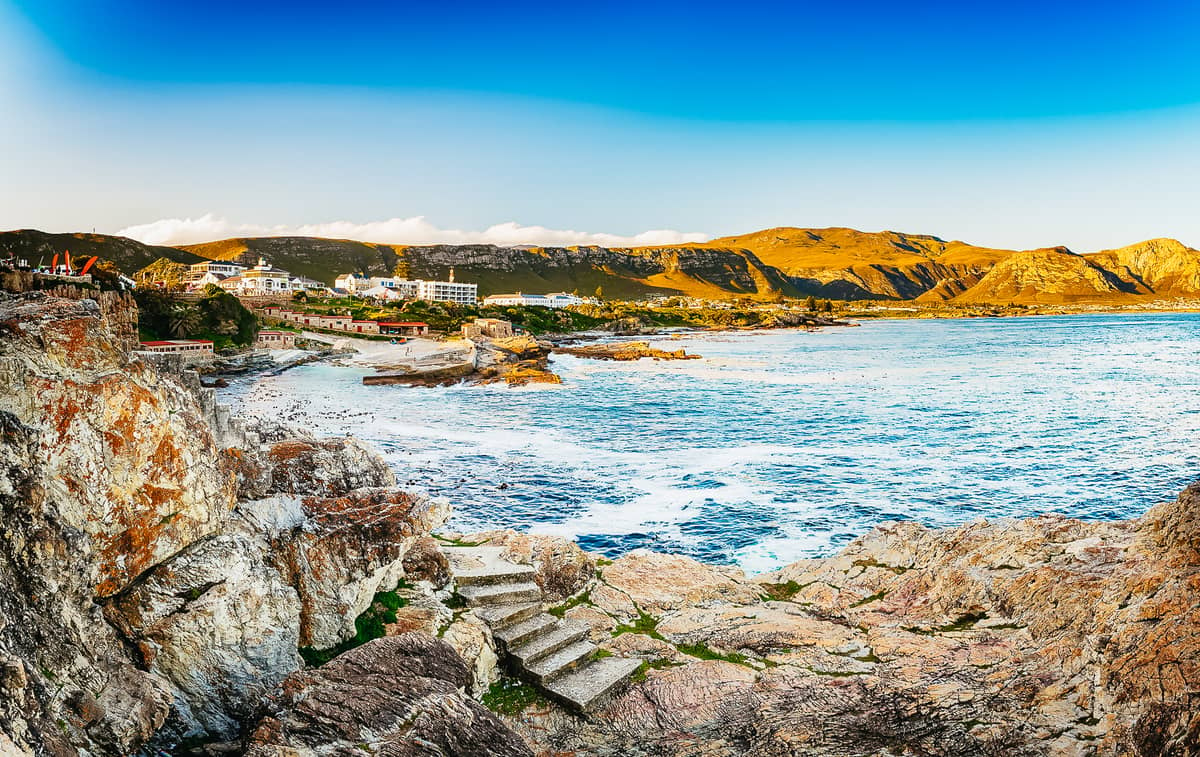
One of the best things about Hermanus is that you can see southern rights without leaving dry land. The Cliff Path runs along the coast, and at certain points the whales come as close as five meters from the shore.4 Mothers and calves especially like the shallow, sheltered water, which brings them close to the rocks.
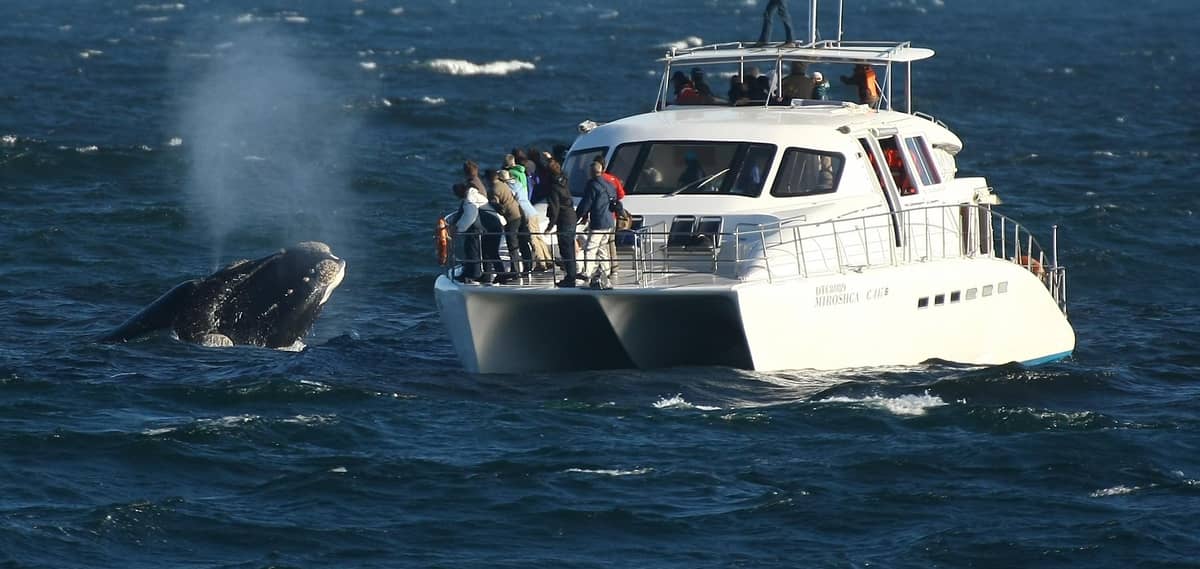
A boat gives you a different view. You reach whales that stay further out, see them at eye level and hear their blows up close. On this site's tour you go out on a purpose-built catamaran with a whale specialist guide, and the trip lasts 2 hours. For many visitors, the best plan is both: the cliffs one day and the boat the next.
Whichever you choose, give yourself time. Whales rest, travel and play in their own rhythm, and the best moments rarely come in the first few minutes. Bring warm clothes, a camera and patience, and you will leave Hermanus with a much better idea of who these whales are.
Book your trip
A southern right may be waiting in the bay.
Book the catamaran now, settle up later, and stay free to cancel until the eve of sailing.


You ask,we answer.
Which whales can you see in Hermanus?
Southern right, humpback and Bryde's whales. CapeNature names the southern right, the humpback and Bryde's whale for the sheltered water of Walker Bay.2
Why do southern right whales come to Hermanus?
To calve and mate. They migrate from the Antarctic around June to calve and mate in the bay.1
When are calves born?
In August and September. Calving takes place in these months, before the males arrive in October.1
How often does a southern right have a calf?
About every three years. The mean calving interval off South Africa is estimated at 3.12 years.3
Are there dolphins in Hermanus?
Yes, through the year. The operator of this site's boat trip says Bryde's whales and dolphins are seen all year round.
How close can boats get to whales?
Only with a permit. Everyone must keep 300 meters away from any whale unless a permit allows a closer approach.9
Are southern right whales protected?
Yes, since 1935. SANBI notes the protection of 1935 and the illegal Soviet hunt that later slowed their recovery.6
Sources
What this guide is based on
- 1Hermanus.co.zaWhale Watching↩
- 2CapeNatureWalker Bay Nature Reserve↩
- 3International Whaling CommissionDemographic parameters of southern right whales off South Africa↩
- 4Hermanus.co.zaWhale Watching - Hermanus↩
- 5Hermanus Whale WatchersWhale Watching with Hermanus Whale Watchers↩
- 6↩
- 7Hermanus Whale WatchersWhale Watching with Hermanus Whale Watchers↩
- 8South African TourismCome greet the giants - southern right whale conservation↩
- 9South African GovernmentEnvironment, Forestry and Fisheries on harassment of whales super-groups↩
- 10CapeNatureWalker Bay Nature Reserve↩
Keep reading